
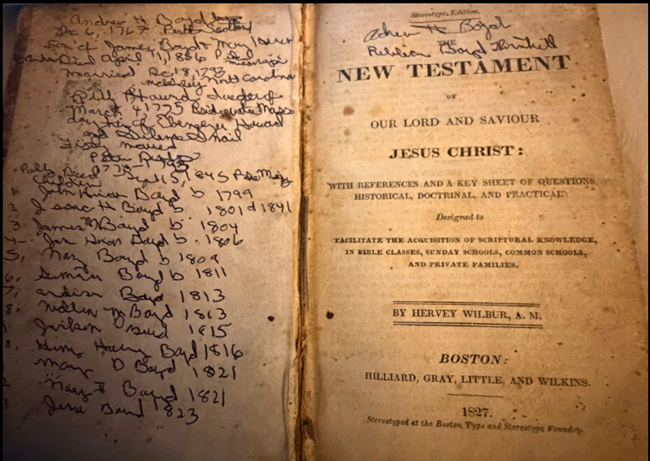
Every record used for historical research must be critically analyzed, without bias or emotion. Every physical detail of a document or source needs to be appraised. Each and every assertion drawn from the content of that source must be tested against other evidence—internal and external—to determine whether that specific assertion is reliable. Critical analysis is a time-honored standard for historical research.
This QuickLesson demonstrates the process of critically analyzing a "record" found online. It uses a time-honored source type, generically called a Family Bible Record. It demonstrates how to separate the physical characteristics of the source (a legitimately published heirloom Bible) from the internal content (created by a user of one copy of that book).
CASE: THE ALLEGED BIBLE OF ANDREW H. BOYD
A FamilySearch contributor has posted at that site an image purporting to be a page from the “Bible of Andrew H. Boyd.”[1] The contributor also attached a note to the FamilySearch Family Tree profile of Andrew Boyd (K2F2-T94; 1759–1856) stating, “I was handed down this Bible from my grandfather Henry Victor Martin, his grandmother was Rebecca Boyd – she most likely was the one that filled out all information” and added that the Bible was published in 1823.[2]
The suggested creator of this “family record" page, Rebecca Boyd, was the granddaughter of Andrew Boyd (K2F2-T94), through his son Isaac (K24P-8C2; 1801–1845). Her FamilySearch profile identifies her as Rebecca Anne Boyd (KGY7-Q95; 1832–1928), wife of Leroy Clement Thornhill (94CL-4ZY; 1833–1880). The FamilySearch profile for the grandson/grandfather cited in the contributor’s chain of custody is Henry Victor Martin (LCQQ-HKM; 1891–1977).
Overall Evaluation:
While the entries appear to have been made within an heirloom Bible, the physical characteristics and content attest three things:
- The entries are not contemporaneous to the events they cover.
- The entries were not created by Andrew Boyd or his (second) wife Polly Howard.
- The entry for “Andrew H. Boyd” and his wife Polly Howard assert birth, marriage, and death details that are soundly disproved by outside evidence.
If this record was created by Rebecca Boyd (as asserted) in her elderly years (as the penmanship implies), it was likely created in the first two decades of the 1900s. However, the specific content—from published sources erroneously linked to Andrew and Polly—suggests that the pages were created a generation after Rebecca’s 1928 demise.
The time frame and the nature of the demonstrably false information suggest that the details were recorded in the Bible to provide “evidence” connecting this South Mississippi farm family to old New England roots for the purpose of a lineage-society application—specifically to connect Polly Howard to the Massachusetts Revolutionary War soldier Ebenezer Howard and to make her the mother of Rebecca Boyd's father Isaac (Andrew's second son by his first wife).
Physical Characteristics:
The image of the “family record" page depicts shaky writing on the yellowed flyleaf of a book whose facing title page is clipped off. All entries (ranging from 1767 to 1845), were clearly made at one sitting, with the same pen and ink, recording events long after they occurred. There are none of the variances in ink shading, nub sizes and weights, or penmanship that occur when entries are made contemporaneously with the events across many decades.While Andrew Boyd lived through the years covered by the list of children, the penmanship and misspellings would not be his. At age eighty, in 1850, Andrew Boyd was still a schoolteacher—a literate and cognitively aware man teaching penmanship and spelling to the community's youth.
The FamilySearch image provides no publication information of the type used to validate heirloom Bibles. However, another image of this page is posted at Find A Grave. That image includes the title page.[3] It identifies the Bible as an edition produced by Hervey Wilbur,[4] a short-term Congregationalist minister and long-term educator, who published a number of catechisms and treatises.[5] That Bible promotes Presbyterianism, the faith followed by Andrew Boyd’s parents when they immigrated to Queensborough, Georgia.[6] However, the Congregationalist-Presbyterian doctrines promoted by Wilbur were radically at odds with those of the Mississippi Baptist church where Polly Howard made her first appearance in Pike County, Mississippi.[7]
The Bible’s title page carries two notations in its top margin: “Adrew H. Boyd” [sic] and “Rebecca Boyd Thornhill.” Both are in the penmanship of the person who penned the entries on the facing flyleaf. That person clearly was not Andrew Boyd himself.
Internal Content:
Controversies over the legitimacy of the Bible’s “family record” page (not the Bible itself) focus on its first entry:
“Andrew H. Boyd”, born “Dec. 6, 1767 Perth Scotland, son of James Boyd & Mary Heren. Andrew Died April 1, 1856, Pike, Mississippi. Married Dec. 18, 1793, Mcklnberg, North Carolina, Polly Haurd, daugter of Bridgewater Mass [sic] daughtr of Ebenezer Howard and Silence Snail. Firstly married Peter Dunlap (1778-1793). Polly Died Sept 15, 1845, Pike, Miss.”
After citing exact birthdate, birthplace, and parents for both “Andrew H.” and his wife, this “family record” then lists thirteen children with no detail other than name and a year.
Problematic issues:
(1) The striking contrast between the fulsome information on the family progenitors and the limited information on each of their children speaks to the creation of this “record” long after the facts recorded thereon. Note that the information appears in a genealogical format: First, the requisite birth date, birth place, parentage, marriage, and death details for the husband and wife, then a bare-bones list of children with no specific details. The presentation attests that the compiler had limited knowledge about the personal details of the children born to the featured couple—or little impetus to obtain the information. If this were indeed the Bible of the immigrant Andrew, supplying extensive information on his own background and that of his wife, we would not see every child’s birth reduced to just a year.
(2) The entry for the birth of “Andrew H. Boyd” does not identify him as Andrew Harrison Boyd, the name repeatedly alleged by past FamilySearch contributors. By contrast, in all the dozens of documents created by Andrew Boyd himself, across his life, he identified himself simply “Andrew Boyd.”[8]
(3) The birth date, place, and parents alleged for “Andrew H. Boyd” cannot be confirmed with any surviving registrations or christenings of that locale. Drawing from the Bible record, the contributor (also on 16 September 2026) altered the birth data for Andrew Boyd (K2F2-T94) to read “1767 Perth, Perth and Kinross, Scotland,” then cited, “Andrew H. Boyd’s Family Bible, and Scotland’s People Birth record.”
Scotland’s People does offers the registration of a child Andrew born that day to “James Boyd, Senior” (not James Boyd and Mary Heren) in the hamlet of Newbiggen, Cargill Parish, in Perth.[9] However,
- A full search of the website reveals no record of a contemporary James Boyd in Scotland married to a Mary Heren (or any similar spelling). It does offer baptisms for additional children born to James Sr. of Cargill Parish and a younger James in the 1760s and 1770s—continuing after the 1769 settlement of the Boyds at Queensborough, Georgia.
- The surname “Boyd” is extremely common across Scotland. The births database at Scotland’s People, for example, reports sixteen different “Andrew Boyd” christenings in the 1750–1770 period—four of them with fathers named James.
- Another of those Andrew Boyd births/christenings (Andrew, born 1769 to Andrew Boyd and Janet Fleming) is also periodically assigned to Andrew Boyd (K2F2-T94) by FamilySearch contributors. All did so without proffering any evidence to connect Andrew Sr. and Janet to Andrew of Georgia and Mississippi.[10]
(4) No known evidence supports an assertion that Andrew Boyd of Mississippi was born in Scotland—and all known evidence contradicts it. Andrew and his parents and uncles arrived in Queensborough, Georgia, in late 1769 among John Rae’s “100 poor Ulster families.”[11] The nine counties of Ulster in which Rae recruited his families are in Ireland—predominantly Northern Ireland—not Scotland. The only document that states a birthplace and age for Andrew Boyd (K2F2-T94) states a birth in Ireland, and an age of 80 (i.e., born 2 June 1769–1 June 1770). Andrew, who is identified thereon as a school teacher (i.e., a literate and cognitively aware man), would not likely misstate so badly his birthplace and age.[12]
(5) The Bible’s subsequent list of children has a second anomaly not seen in “family Bible records” created by parents: Six of the thirteen listed children are cited with a middle initial (only an initial), reflecting incomplete knowledge on the part of the scribe. Parents, in creating a contemporary family record of their children’s births, as each happened, record each name in full.
(6) The assertion that Andrew Boyd of Georgia and Mississippi wed in North Carolina (1793) to Polly Howard of Massachusetts, widow of Peter Dunbar” fails all evidentiary tests. As evidence, the image’s contributor links to a Find a Grave memorial page that makes the same claim. To support the claim, that memorial page offers three unidentified snippets from published vital records”[13]
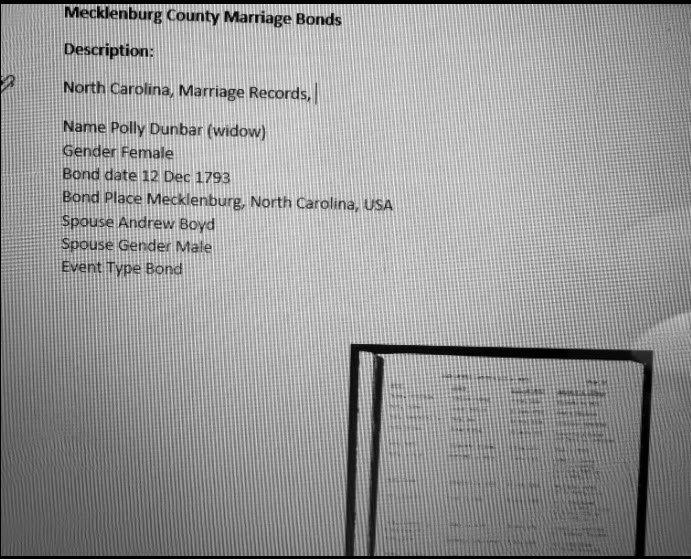
SNIPPET 1: from a source whose configuration suggests it is a database entry, embeds an image from another source on which details are unreadable. The unidentified “database” section of the image states “Mecklenburg County Marriage Bonds ... Name Polly Dunbar (widow) ... spouse Andrew Boyd ... bond date 12 December 1793.” Mecklenburg County’s marriage bonds were published in 1942 and 1981, by different parties, each of whom identify that 1793 bride of one Andrew Boyd as Sarah Dunbarr (not Polly) with no notation at all of a single or widowed status. The format and type of the embedded image, on which the names are too small and blurred to read, matches the corresponding page in the 1942 abstracts published by FamilySearch’s predecessor, Genealogical Society of Utah.[14]
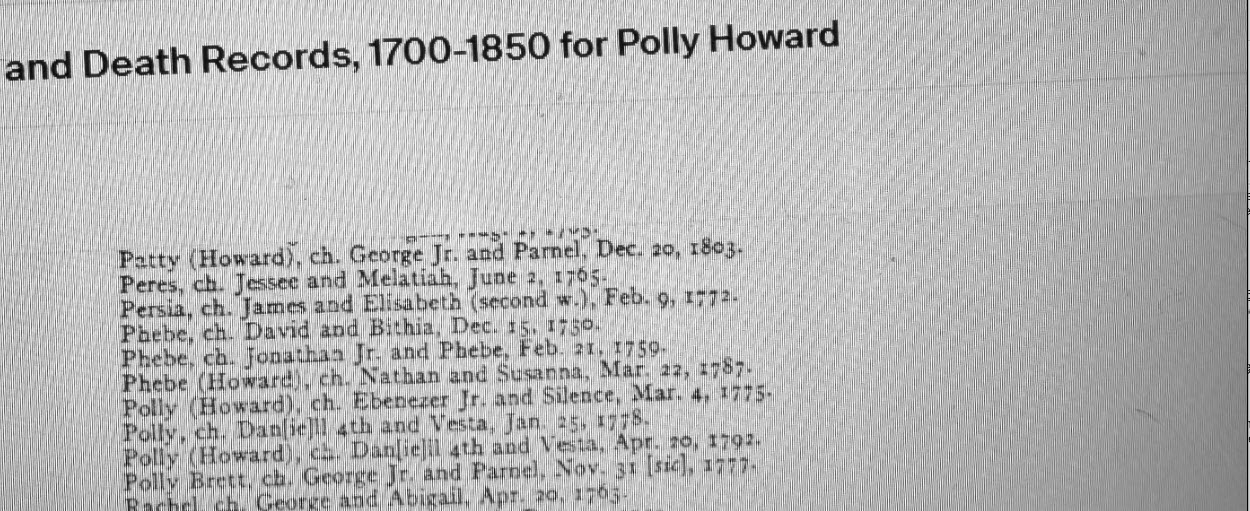
SNIPPET 2: from a printed source listing vital records for an unidentified place, states: “Polly (Howard) ch. Ebenezer Jr. and Silence, Mar. 4, 1775.”[15] The unidentified source is a respected set of vital records published in 1916 by the New England Historic Genealogical Society, reporting births in the town of Bridgewater, Massachusetts.[16] That birth was originally recorded in the Bridgewater town registers as part of a family group for the Ebenezer Howard household.[17] It is a legitimate record, but no known document links this Polly to the Mississippi woman.
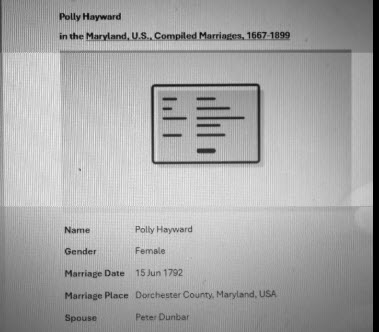
SNIPPET 3: from a database labeled “Maryland U.S. Compiled Marriage, 1667-1899,” citing the marriage of “Polly Hayward ... 15 Jun 1792, Dorchester County, Maryland, to Peter Dunbar.” The Find A Grave creator added a label: “Marriage ... Peter Dunbar and Polly Howard June 15, 1792, Dorchester County, MA.”[18] A database of that title is found at Ancestry.[19]
Problem 1: The bride shown in the database is one Polly Hayward, not Howard. While those two spellings sometime appear as variants for each other, they more often represent distinctly different families. Dorchester has no marriages in that decade for anyone using the spelling “Howard.” The twelve marriages for that decade are all consistently “Hayward.”
Problem 2: This is a Maryland database, not Massachusetts. The Find A Grave page attempts to blur the difference by relabeling the location as Dorchester County, MA (the postal code abbreviation for Massachusetts) rather than MD (the correct code for Maryland).
Problem 3: No evidence is provided to link this Maryland couple to the Polly Howard of Bridgewater, Massachusetts—or to explain how and why a 17-year-old girl, whose parents were still in Massachusetts, was getting married some 500 miles away in Maryland.
The Find A Grave creator (who appears to also be the contributor of the Bible image at FamilySearch), adds a fourth source to her “Polly Mary Howard” profile within her Ancestry tree:[20] a page image from published Massachusetts vital records showing the death of one “Dunbar Peter, s. Lt. Peter and Relief, Mar. 1, 1795, in 21st y.”[21]
Problem 4: This 21-year-old Peter Dunbar is identified as “son of,” implying that he was not married. “Husband of” does appear throughout for other men in this compiled volume and “h” for husband appears on the compiler’s list of standard abbreviations being used. The “h” does not appear in the Peter Dunbar entry, only an “s” for son of.
Problem 5: No evidence is offered to establish that this 21-year-old Peter Dunbar of Massachusetts is the Peter Dunbar who married three years earlier some 500 miles away in Maryland.
In sum: the contributor of the “Bible record” to FamilySearch argues that Polly (Howard) Boyd of Mississippi
- was born 4 March 1775 in Massachusetts;
- married Peter Dunbar in 1792 in Maryland, as a 17-year-old girl 500 miles from home, using the surname Heyward;
- became a widow in March 1795 when her 21-year old husband died in Massachusetts;
- but also married 15 months before her husband’s death, 900 miles away in backcountry Mecklenburg County, NC under the name “Sarah Dunbarr,” rather than her actual given name Polly.
Outside evidence also disproves this irrational “chain of evidence.” See Issues 7 and 8.
(7) Mary “Polly” Howard, christened 1775 as the daughter of Ebenezer, was an entirely different woman, whose life has been reliably documented as the wife of Asa Bly. See FamilySearch profile K87N-YFR.
(8) The Mecklenburg Andrew Boyd was not Andrew Boyd (K2F2-T94), husband of Polly Howard. Andrew’s life has been extensively researched and documented, month-by-month, year-by-year.[22] No known evidence places Andrew Boyd of Georgia and Mississippi in the state of North Carolina in 1793 or any other year; and the contributor of this “Bible record” offers none. Moreover, the Mecklenburg Andrew, who wed Sarah Dunbarr, was still there on Mecklenburg’s 1800 census when our Andrew Boyd (K2F2-T94) was a taxed landowner in Jefferson Co., Georgia.[23]
(9) No evidence exists of a marriage for our Andrew Boyd until 1798. The evidence for that event and time frame places him in Burke (later Jefferson County), Georgia, where he, his mother, and his siblings resided. All evidence points to the identity of his first wife as the daughter of the Jefferson Co. settler John Taggert—whose land Andrew took over and whose name was given to Andrew’s first son, John T. Boyd.[24]
(10) Mississippi’s evidence for the identity of Andrew Boyd’s wife Polly Howard establishes a significantly different identity than that of the Massachusetts woman.
Problem 1: Andrew’s Polly first appears on record in Pike Co., Miss. as Polly E. Howard, entered onto the rolls of the Bogue Chitto Baptist Church.[25] Had she been Andrew’s wife since 1793, she would have been entered onto those rolls under the name “Polly Boyd,” the name she would have used for twenty-four years, not under her maiden name.
Problem 2: It is highly improbable that Polly Howard, born and christened in the Congregationalist Church in Plymouth County, Massachusetts, would make her first appearance in Mississippi as a member of a Baptist church. The tenets of those two churches are radically different. It is also germane to note that “Polly Howard Boyd” withdrew from that Baptist Church in 1822, after her marriage to the Scots-Irish Presbyterian Andrew Boyd.
Problem 3: The only known census data for Polly, wife of Andrew, places her birth between 1790 and 1800. That is fifteen to twenty-five years younger than the same-name woman christened in Massachusetts. Born 1790–1800, Polly would not be the woman who began bearing children for Andrew beginning in 1799.[26]
Conclusion: This so-called “family Bible page” was created with a specific purpose, drawing from published sources that had become available in genealogical libraries by the mid-1900s. It represents a type of “record” commonly seen in lineage society applications of that era, cobbling together whatever is found for a “name” of interest—random records, from disparate families, in disparate places—to support a desired narrative that subsequent generations are now disproving through deeper research into individual lives.
[1] FamilySearch (https://www.familysearch.org/en/memories/memory/248234456), posted by “szyq71”; this image is now attached to many profiles of the descendants of Andrew Boyd (K2F2-T94). The Bible is imaged in the Appendix.
[2] Ibid., https://www.familysearch.org/en/tree/person/changelog/K2F2-T94, posted 16 September 2026 by Szyq71.
[3] Find A Grave (https://www.findagrave.com/memorial/267131258/polly-mary-dunbar_boyd#view-photo=350640867 : accessed 17 September 2026), attached to the memorial page for “Polly Mary Howard Dunbar Boyd, created by Suzan Martin. No tombstone image is supplied (and no stone is known to exist) for Andrew Boyd or either of his wives, all of whom died in Pike County. Pike’s courthouse records pre-1882 are also destroyed; hence no civil marriage or probate records.
[4] Hervey Wilbur, A.M., The New Testament of Our Lord and Saviour Jesus Christ: With References and a Key Sheet of Questions Historical, Doctrinal, and Practical, Designed to Facilitate the Acquisition of Scriptural Knowledge in Bible Classes, Sunday Schools, Common Schools, and Private Families (Boston: Hilliard, Gray, Little, and Wilkins), 1827.
[5] For example, see Hervey Wilbur, A Discourse on the Religious Education of Youth Delivered at Homer (N.Y.) on the Evening Previous to the Meeting of Synod, 2d ed. (Boston: Nathaniel Willis for the Genesee (N.Y.) Missionary Society, 1814), and Wilbur, A Short Biblical Catechism ... (Exeter: C. Norris, 1812). A biography of Wilbur appears in James Grant Wilson and John Fiske, Appletons’ Cyclopaedia of American Biography (New York: D. Appleton, 1889), p. 503.
[6] A full copy of this Bible can be found imaged at Wikimedia Commons (https://upload.wikimedia.org/wikipedia/commons/7/7c/The_New_Testament_of_our_Lord_and_Saviour_Jesus_Christ_with_references_.._%28IA_newtestamefou00%29.pdf : 17 September 2026). See, for example, the editors “Remarks” on image 334 (unpaginated), where he states that his “Key Sheet” instructions were from a “plan ... recommended by the General Assembly of the Presbyterian Church.
[7] Bogue Chitto Baptist Church Minutes, 1817 membership roll; microfilm roll 36269, catalog no. Z1623.000, Mississippi Department of Archives and History, Jackson.
[8] For abstracts, transcripts, and/or images of all proved records for Andrew Boyd, see Elizabeth Shown Mills, Jane’s Offspring: Scots-Irish Boyds in Georgia and Mississippi, last updated 5 October 2022); PDF online at Mills, Historic Pathways (https://www.historicpathways.com/download/JanesOffspringFirstSixGenerations.pdf).
[9] “Births and Baptisms—Old Parish Registers,” Scotland’s People (https://www.scotlandspeople.gov.uk/record-results/14781243316aad8b702c880), from the index entry citing Parish Number 338, Ref 10/118, Parish Cargill, an image copy can be purchased for study. That study has been done; but the image cannot be republished online under the terms and conditions of the website.
[10] For example, see the alteration made 21 July 2026 by “MacDonaldDerekScott1” who also altered the christening record to identify the father as “James Andrew” Boyd.
[11] Kerby A. Miller, “Scotch-Irish, ‘Black Irish’ and ‘Real Irish’: Emigrants and Identities in the Old South,” in Andy Bielenberg, ed., The Irish Diaspora (Harlow, England: Longman, 2000), 145. Also see Loris D. Cofer, Queensborough, or the Irish Town and Its Citizens (N.P.: P.P., 1977).
[12] 1850 U.S. census, Pike Co., Miss., pop. sch., police dist. 3, p. 32 (stamped), dwelling 416, family 417. The census statement that Andrew was aged 80 places his birth between 2 June 1769 and 1 June 1770. Given that the Hopewell passengers arrived in the Georgia colony in November 1769, his birth would have occurred in the summer of 1769 before his parents left Northern Ireland.
[13] Find A Grave (https://www.findagrave.com/memorial/267131258/polly-mary-dunbar_boyd) > memorial page for “Polly Mary Howard Dunbar Boyd.
[14] Brent H. Holcomb, Marriages of Mecklenburg County, North Carolina, 1783—1868 (Baltimore: Genealogical Publishing Co., 1981), p. 25. Indexed abstracts of these records were first publicly accessible in 1942 as typed manuscripts supplied to libraries by the Genealogical Society of Utah, “Mecklenburg County North Carolina, Marriage Bonds (Typescript, Salt Lake City, 1942); now imaged, FamilySearch (https://www.familysearch.org/ark:/61903/3:1:S3HT-XXX7-9R6 ) > IGN 004364068 > image 297 of 618.
[15] Find A Grave (https://www.findagrave.com/memorial/267131258/polly_mary-dunbar_boyd/photo#view-photo=332976), memorial page for "Polly Mary Howard Dunbar Boyd."
[16] Vital Records of Bridgewater, Massachusetts, to the Year 1850, Volume 1—Births (Boston: New England Historic Genealogical Society for the Eddy Town-Record Fund, 1916), p. 140; imaged, “Massachusetts, U.S., Compiled Birth, Marriage, and Death Records, 1700–1850,” Ancestry (https://www.ancestry.com/imageviewer/collections/61401/images/dvm_primsrc000028-00139 : accessed 17 September 2026) > image 140 of 947
[17] “Massachusetts, U.S., Town and Vital Records, 1620–1988” (https://www.ancestry.com/imageviewer/collections/2495
/images/40369_263917__0054-00217?pId=10847342 : accessed 17 September 2026) > Bridgewater > Town Records, with Births, Marriages, and Deaths > image 125 of 1466.
[18] Find A Grave (https://www.findagrave.com/memorial/267131258/polly-mary-dunbar_boyd#view-photo=333014281) > memorial page for "Polly Mary Howard Dunbar Boyd.
[19] “Maryland, U.S., Compiled Marriages, 1667–1899,” Ancestry (https://www.ancestry.com/search/collections/4729 : accessed 17 September 2026).
[20] Suzan Martin, “Family Main Tree 2026,” Ancestry https://www.ancestry.com/family-tree/person/tree/111701831/person/430129193113/facts : accessed 17 September 2026) > profile for “Polly Mary Howard.”
[21] Vital Records of Brockton, Massachusetts to the Year 1850 (Boston: New England Historic Genealogical Society for the Eddy Town-Record Fund), p. 324; imaged, “Massachusetts, U.S., Compiled Birth, Marriage, and Death Records, 1700–1850,” Ancestry (https://www.ancestry.com/imageviewer/collections/61401/images/dvm_primsrc000030-00323 : accessed 17 September 2026) > image 322 of 369.
[22] Mills, Jane’s Offspring: Scots-Irish Boyds in Georgia and Mississippi, last updated 5 October 2022), particularly 5, 11–47.
[23] Andrew Boyd household, male 26–44, female 26–44, children: 3 under the age of 10. 1800 census, Mecklenburg Co., NC, stamped p. 579, line 11.
[24] Mills, Jane’s Offspring,” see particularly 9–18, 21–31.
[25] Bogue Chitto Baptist Church Minutes, 1817 membership roll; microfilm roll 36269, catalog no. Z1623.000, Mississippi Department of Archives and History, Jackson. This reading is also reported in Tempe Fenn Crosby et al, Andrew Boyd, 1770–1856, and His Descendants (Sautee, GA: Singing Turtle Press, 1993), 387.
[26] 1840 U.S. census, Pike Co., Miss., stamped p. 165 verso, line 5. The 1830 census of Pike is missing. By the 1850 census, Andrew is a widower.
[27] Find A Grave (https://www.findagrave.com/memorial/267131258/polly-mary-dunbar_boyd) > memorial page for “Polly Mary Howard Dunbar Boyd.